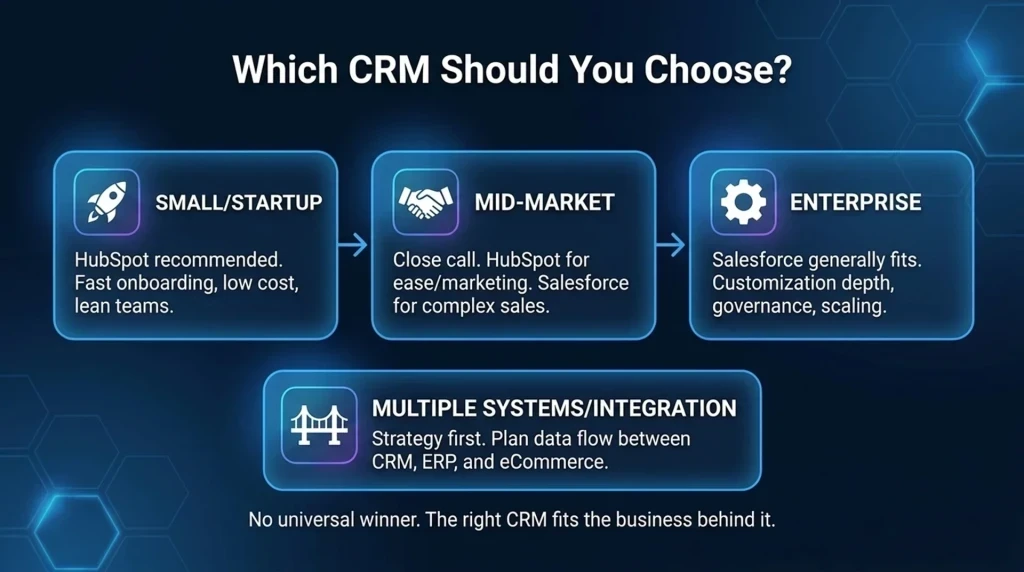
Selecting an enterprise CRM in 2026 is an architectural alignment and change management decision rather than a feature comparison. With over 60% of CRM failures driven by adoption resistance and administrative drag rather than software shortcomings, the right platform is determined by your existing IT stack, administrative capacity, and data governance requirements.
Research published by resources.rework.com indicates that 91% of companies with more than 10 employees now operate a customer relationship management system, expanding the global market toward a projected $126.2 billion. Despite near-universal adoption, the operational gap between high-performing revenue engines and multi-million-dollar shelfware remains wide. Enterprise procurement committees often make the mistake of evaluating software via feature checklists instead of analyzing operational run-rates, schema flexibility, and user friction.
What Separates Enterprise CRM from Mid-Market Systems
An enterprise CRM differs from standard CRM software through architectural scalability, multi-entity governance, custom object schemas, granular role-based access controls, and compliance certifications like SOC 2 and GDPR. In 2026, enterprise platforms function as cross-functional data operating layers that unify sales, marketing, and ERP pipelines across global operating units.
While mid-market systems focus on pipeline visualization for unified sales teams, enterprise deployments coordinate operations across distinct subsidiaries, multi-currency accounting structures, and divergent go-to-market motions. Industry analysis from Huble highlights that platform consolidation has emerged as the dominant enterprise trend: organizations are actively retiring fragmented point solutions to reduce SaaS bloat and unify customer records under a central governance model.
Achieving this consolidation requires structural capabilities that mid-market tools cannot support:
- Polymorphic Custom Objects and Extensible Data Schemas: Enterprise systems allow architects to model complex B2B business structures beyond standard contact-account-deal hierarchies, supporting parent-child holding models, asset-based servicing, and consumption-based billing models.
- Multi-Jurisdiction Governance and Statutory Compliance: Large organizations require precise data isolation, sovereign cloud hosting, and compliance readiness for mandates such as the European Accessibility Act (EAA), WCAG 2.2 AA standards, and localized data privacy laws.
- Enterprise Identity and Granular Access Controls: Security models must enforce field-level security, record sharing rules based on business units, and conditional access policies integrated with central identity providers.
- Decoupled Storage and Zero-Copy Virtualization: Modern enterprise stacks increasingly link CRM platforms directly to enterprise data lakes and cloud data warehouses, enabling teams to query core financial and behavioral data without paying for proprietary CRM database storage.
How AI Workflows and Unified Data Architecture Reshape CRM
Machine learning workflows and autonomous software agents deliver tangible value only when anchored to disciplined, well-governed data. As technology consultancy Clarity observed regarding enterprise system design:
AI is useful when it sits on top of usable data.
Without structured activity logs, clean account hierarchies, and deduplicated pipeline records, predictive scoring and automated workflows generate flawed insights.
Platform vendors approach intelligent workflow automation with divergent architectural strategies. Salesforce gates its Agentforce autonomous intelligence platform behind its highest-tier Enterprise and Unlimited licensing plans. In contrast, Microsoft bundles its Copilot capabilities directly into the Dynamics 365 Sales Premium license tier ($150 per user per month), eliminating the need for standalone add-on subscriptions for advanced revenue intelligence and predictive pipeline scoring.
Adoption rates in 2026 demonstrate that revenue teams gain the most value from contextual, in-workflow assistance rather than standalone conversational portals. Copilot embedded natively within Microsoft Outlook sidebars and Teams meeting summaries enables account executives to capture conversation records, log customer commitments, and generate pipeline summaries without switching browser tabs. Evaluations by resources.rework.com reveal that AI-powered call transcription, opportunity health scoring, and pipeline gap detection deliver dependable operational value, whereas automated customer email generation continues to produce mixed results depending on target audience profiles.
CIOs and RevOps leaders must also evaluate the governance and regulatory posture of vendor AI engines. Deploying generative tools across enterprise customer data introduces shadow exposure risks, where large language model retrieval mechanisms can inadvertently expose executive pricing tiers or confidential account margins across role hierarchies. Enterprise procurement teams require contractual commitments ensuring that AI agents strictly observe field-level permissions and comply with regional frameworks such as the European Union AI Act.
Salesforce, Dynamics 365, and HubSpot: 2026 Platform Breakdown
The choice between leading enterprise CRMs in 2026 hinges on ecosystem gravity and organizational maturity. Salesforce leads in third-party marketplace scale and complex customization; Microsoft Dynamics 365 excels in native Microsoft 365 and ERP integration with bundled Copilot; HubSpot Sales Hub Enterprise delivers rapid deployment and superior rep adoption without dedicated administrative overhead.
Market dominance remains concentrated at the top. The Gartner Magic Quadrant for CRM Sales Platforms placed Salesforce and Microsoft as the sole Leaders in the market. The evaluation recognized both Salesforce and Microsoft as longstanding Leaders in the quadrant. Market share figures published by Salesforce show Salesforce maintaining 20.0% of the worldwide CRM market at the close of 2025, with Microsoft holding 4.0%.
The following comparison breaks down the core commercial, architectural, and operational profiles of the top three platforms alongside notable challengers.
Platform |
Base Enterprise Pricing |
Architectural Strengths |
Ecosystem Synergy |
Key Implementation Trade-Off |
|---|---|---|---|---|
Salesforce Sales Cloud Enterprise |
$175/user/month |
Unmatched schema flexibility, granular sharing rules, enterprise data fabric |
AppExchange ecosystem containing over 7,000 verified enterprise applications |
High total cost of ownership; demands full-time dedicated administration |
Microsoft Dynamics 365 Sales Enterprise |
$105/user/month |
Native Microsoft Fabric alignment, integrated Copilot revenue intelligence |
Direct Microsoft Entra ID, Outlook, Teams, and Power Platform connectivity |
Complex initial configuration; high systems-integrator consulting fees |
HubSpot Sales Hub Enterprise |
$150/seat/month |
Clean single-codebase UI, rapid rep adoption, native marketing alignment |
Unified Smart CRM database with direct operational hub connectivity |
Reduced custom governance controls for highly matrixed conglomerates |
Creatio |
Custom Quote |
No-code composable process automation architecture |
Open API framework for bespoke third-party enterprise integrations |
Smaller partner ecosystem compared to dominant tier-one providers |
SugarCRM |
Custom Quote |
Predictive pipeline analytics and historical change capture |
Standard SQL-friendly data models and flexible deployment options |
Requires deliberate internal engineering to match top-tier marketplace apps |
Zoho CRM |
Enterprise Tiers |
Cost-efficient multi-channel sales execution for growing estates |
Native connectivity across the broader Zoho corporate application suite |
Lacks complex multi-entity governance required by Fortune 500 enterprises |
Understanding these commercial and structural distinctions allows evaluation teams to map specific organizational constraints against platform strengths.
Salesforce: Maximum Extensibility and Ecosystem Breadth
Salesforce remains the industry benchmark for complex business logic, custom apex code execution, and multi-layered organizational hierarchies. Its Enterprise edition ($175 per user per month) provides the foundation for heavily customized revenue operations. Supported by the AppExchange marketplace and its extensive catalogue of applications, Salesforce can be molded around virtually any industry sales motion. However, maintaining this level of extensibility requires substantial administrative staffing, third-party middleware, and ongoing development to prevent technical debt from slowing release cycles.
Microsoft Dynamics 365 Sales: Unified Microsoft Stack and Native Copilot
Dynamics 365 Sales Enterprise ($105 per user per month) is the logical choice for enterprises standardized on Microsoft enterprise agreements, Microsoft Entra ID authentication, and Azure data estates. The platform removes user adoption barriers by embedding CRM interaction directly into Outlook interfaces and Microsoft Teams meeting spaces. Furthermore, its native synchronization with Dynamics financial and supply chain applications prevents the field-mapping conflicts that frequently undermine enterprise CRM projects when syncing with third-party ERPs.
HubSpot Sales Hub Enterprise: Rapid Deployment and Clean Usability
HubSpot Sales Hub Enterprise ($150 per seat per month) challenges traditional enterprise software architectures through its single-codebase structure. Rather than bolting acquired technologies together, HubSpot built its CRM, marketing, and service applications on a unified data layer. This approach accelerates time-to-value from quarters to weeks while delivering high user adoption across sales teams. HubSpot also provides European data residency through its dedicated Frankfurt am Main infrastructure, satisfying strict GDPR and German compliance requirements. The trade-off centers on edge-case customizations: highly complex conglomerates with layered corporate holding structures may outgrow HubSpot’s standard permission boundaries.
Niche Challengers: Creatio, SugarCRM, and Zoho
Specialized enterprise alternatives offer distinct operational advantages for specific use cases. Creatio delivers no-code composable workflows that allow business analysts to assemble complex sales processes without dedicated software engineers. SugarCRM focuses on predictive analytics, tracking historical changes to give revenue leaders clear visibility into pipeline shifts. Zoho CRM delivers a cost-efficient architecture for mid-market to enterprise companies looking to escape expensive per-seat software renewals, though it requires disciplined internal architecture to support complex multi-divisional enterprises.
What Does an Enterprise CRM Really Cost Beyond Sticker Prices?
Published license pricing represents only a fraction of three-year enterprise software expenditure. Procurement teams that evaluate systems based solely on monthly per-user rates consistently encounter budget overruns caused by mandatory services, administrative overhead, and tier-gated add-on software modules.
Total Cost of Ownership Warning: Technology evaluation firm Clarity warns enterprise buyers:
Buying ahead of complexity is the more expensive mistake of the two.
Procuring sophisticated governance and custom object tiers before internal sales processes actually require them creates unnecessary administrative drag while inflating annual software expenditures.
A comprehensive three-year total cost of ownership (TCO) model must evaluate software tiers, onboarding fees, administrative staffing ratios, add-on modules, and zero-copy data warehouse cost savings across Microsoft-centric, independent, and marketing-led enterprise stacks. For a baseline enterprise deployment of 100 seats over a 36-month lifecycle, the commercial commitments diverge substantially based on platform architecture:
Cost Driver |
Independent Stack (Salesforce Enterprise) |
Microsoft-Centric Stack (Dynamics 365 Sales) |
Marketing-Led Stack (HubSpot Sales Hub Enterprise) |
|---|---|---|---|
Software Tier (100 seats, 3 years) |
$630,000 ($175/user/month base enterprise licensing) |
$378,000 ($105/user/month Sales Enterprise) or $540,000 ($150/user/month Sales Premium) |
$540,000 ($150/seat/month base enterprise licensing) |
Mandatory Onboarding & Implementation |
Phased systems integration consulting and custom data schema migration |
$25,000 to well past $250,000 in specialized SI consulting and ERP alignment |
$3,000 to $7,000 mandatory enterprise onboarding package |
Administrative Ratio & Staffing Overhead |
1 full-time certified administrator required per 75 to 150 users |
1 full-time certified administrator required per 75 to 150 users |
0 dedicated administrators required; RevOps supports higher user counts |
Add-On Modules & AI Intelligence |
Pardot marketing automation from $1,250/month ($45,000 over 3 years); Agentforce gated by tier |
Sales Premium ($150/user/month) bundles Copilot AI and predictive scoring without add-on fees |
Unified single codebase includes marketing and sales without standalone software add-ons |
Zero-Copy Data Warehouse Savings |
Direct virtualization to Snowflake or Databricks eliminates proprietary CRM storage overages |
Native Microsoft Fabric and lakehouse queries eliminate secondary data synchronization costs |
Unified Smart CRM database eliminates multi-system data duplication charges |
Support Surcharges & Escalators |
20% to 30% annual support surcharges; unnegotiated escalators run 5% to 9% |
20% to 30% annual support surcharges; unnegotiated escalators run 5% to 9% |
Standard support included; unnegotiated annual renewal escalators run 5% to 9% |
Analyzing these operational variables reveals the critical levers governing multi-year CRM expenditures:
- Mandatory Onboarding and Implementation Services: HubSpot enforces mandatory onboarding packages for enterprise hubs between $3,000 and $7,000. Enterprise Dynamics deployments demand specialized systems integration consulting, with implementation fees regularly spanning from $25,000 to well past $250,000 depending on custom integration depth and ERP alignment, while Salesforce requires extensive phased SI delivery.
- Marketing and Revenue Operations Add-Ons: Deploying Salesforce Pardot marketing automation introduces baseline costs starting at $1,250 per month ($45,000 over 3 years), with Agentforce autonomous intelligence gated behind Enterprise and Unlimited tiers. In contrast, Dynamics 365 Sales Premium at $150 per user per month bundles Copilot AI capabilities, predictive scoring, and advanced pipeline intelligence without separate add-on subscriptions, while HubSpot eliminates add-on sync middleware by uniting sales and marketing on a single database.
- Administrative Ratios and Technical Debt Maintenance: Complex Salesforce and Dynamics deployments require full-time, certified administrative personnel or specialized agency retainers, maintaining a typical operational ratio of one administrator per 75 to 150 enterprise users. Simpler architectures like HubSpot allow RevOps teams to support significantly higher user counts before adding dedicated system overhead.
- Zero-Copy Data Warehouse Cost Savings: Decoupled storage architectures link CRM platforms directly to enterprise data lakes and cloud warehouses. By querying operational, financial, and behavioral records via zero-copy virtualization, enterprise buyers avoid proprietary CRM database storage tiers, compute add-ons, and point-to-point integration maintenance across independent and Microsoft stacks.
- Contractual Surcharges and Tiered Support: Enterprise service agreements frequently mandate paid support packages running from 20% to 30% of net annual software spend. Combined with non-negotiable annual price escalators running 5% to 9% without negotiated caps, multi-year operating costs escalate rapidly over initial projections.
- Mandatory Onboarding and Implementation Services: HubSpot enforces mandatory onboarding packages for enterprise hubs that range between $3,000 and $7,000. Enterprise Dynamics deployments demand specialized systems integration consulting, with implementation fees regularly spanning from $25,000 to well past $250,000 depending on custom integration depth and ERP alignment.
- Marketing and Revenue Operations Add-Ons: Essential companion modules carry steep price tags. Deploying Salesforce Pardot marketing automation introduces baseline costs starting at $1,250 per month, while premium data enrichment and advanced pipeline analytics require supplementary licensing.
- Administrative Ratios and Technical Debt Maintenance: Complex Salesforce and Dynamics deployments require full-time, certified administrative personnel or specialized agency retainers, maintaining a typical operational ratio of one administrator per 75 to 150 enterprise users. Simpler architectures like HubSpot allow RevOps teams to support significantly higher user counts before adding dedicated system overhead.
- Contractual Surcharges and Tiered Support: Enterprise service agreements frequently mandate paid support packages, running from 20% to 30% of net annual software spend. Combined with non-negotiable annual price escalators (often 5% to 9% without negotiated caps) and sandbox compute charges, operational costs escalate rapidly over multi-year terms.
Why Do Enterprise CRM Implementations Fail?
Historical delivery metrics for enterprise CRM initiatives reflect substantial project risk. Empirical research indicates that between 20% and 70% of enterprise CRM deployments fail to achieve their defined business objectives. Research conducted by Johnny Grow documents a 55% failure rate, while market studies from Forrester place project underperformance at 47%.
Technology consultancy Huble observes that systemic implementation collapse rarely originates from technical architecture:
CRM technology works. CRM adoption doesn’t.
Huble’s research demonstrates that over 60% of CRM project failures stem from organizational resistance, poor change management, and user friction, whereas only 6% to 10% result from software platform defects.
Echoing this operational reality, resources.rework.com summarizes the primary trade-off facing revenue leaders:
A lightweight CRM that your reps actually use will outperform a powerful one nobody logs into.
When enterprise software creates administrative burden without supporting daily selling execution, user adoption breaks down quickly.
Software evaluation firm Salesmate notes that the foundational failure mode in modern enterprises is not an absence of platform features, but persistent operational fragmentation across systems, teams, and workflows. Unmanaged friction triggers specific organizational failure patterns:
- Over-Engineering Ahead of Organizational Maturity: Businesses often spend 12 to 18 months configuring enterprise release governance, nested permission profiles, and validation scripts, only to deploy a rigid system that operates slower than the legacy tools it replaced.
- Proliferation of Shadow Tracking Repositories: When account executives experience CRM data entry as administrative overhead, they track pipeline progress in personal spreadsheets or Notion workspaces, inputting only bare minimum updates into the enterprise platform to appease management.
- Data Corruption and Forecasting Breakdown: Low adoption leads directly to incomplete, duplicate, and stale account records, making automated pipeline forecasts unreliable for executive planning and board reporting.
- The ERP Bi-Directional Synchronization Trap: Organizations frequently treat the enterprise ERP as a secondary integration point rather than an authoritative ledger, resulting in conflicting financial fields, broken billing triggers, and integration errors during active selling cycles.
A Practical Three-Tier Decision Framework for Buyers
Enterprise procurement teams should replace unweighted feature-by-feature vendor checklists with a structured operational decision heuristic. Integrate IQ CEO Tim Ritchie developed a three-question evaluation framework to simplify cross-platform selection, which can be expanded to provide clear criteria for when to select Salesforce, Microsoft Dynamics 365, or HubSpot Enterprise:
- Dedicated Administrator and Developer Capacity: Does your organization employ, or have budget to recruit, full-time certified CRM administrators (maintaining the standard operational ratio of one administrator per 75 to 150 users) and developers? If the answer is no, prioritize HubSpot Sales Hub Enterprise to avoid administrative logjams and multi-year technical debt. If the answer is yes, your organization has the administrative foundation required for Dynamics 365 or Salesforce.
- Core Technology Stack Standardization: Has your enterprise standardized its productivity, collaboration, and data infrastructure around Microsoft 365, Microsoft Entra ID, Teams, Outlook, and Azure? If the answer is yes, Microsoft Dynamics 365 Sales provides immediate ecosystem synergy, native ERP alignment, and bundled Copilot intelligence at $105 to $150 per user per month. If your IT architecture is independent or multi-cloud, prioritize Salesforce to leverage the scale of the AppExchange and its ecosystem of over 7,000 verified enterprise applications.
- Custom Schema Complexity versus Deployment Velocity: Does your organization require rapid deployment and go-live within the current fiscal quarter with unified sales and marketing workflows? If yes, HubSpot fits the required timeline. Conversely, select Salesforce Sales Cloud Enterprise when your business model requires deep polymorphic custom objects, custom Apex code execution, complex parent-child holding hierarchies across global subsidiaries, and granular field-level sharing rules that justify a multi-quarter phased rollout.
- Dedicated Administrator Availability: Does your organization employ, or have budget to recruit, a full-time, certified CRM administrator? If the answer is no, prioritize HubSpot Sales Hub Enterprise to avoid administrative logjams.
- Core Technology Stack Standardization: Has your enterprise standardized its productivity, collaboration, and data infrastructure around Microsoft 365, Entra ID, and Azure? If the answer is yes, Microsoft Dynamics 365 Sales provides immediate ecosystem synergy and pricing efficiencies.
- Deployment Velocity: Must your new sales architecture achieve operational go-live within the current fiscal quarter? If rapid deployment is an operational mandate, HubSpot fits the required timeline, whereas enterprise Salesforce or Dynamics deployments typically require multi-quarter phased rollouts.
To eliminate subjective vendor bias during software demonstrations, procurement committees should implement weighted demo scoring protocols. Reviewers evaluate prospective platforms on a scale of 1 to 5 across core operational capabilities, including offline mobile conflict resolution, CPQ sequence execution, and administrative schema creation. Weighting these categories based on predetermined business priorities prevents internal stakeholders from being swayed by rehearsed vendor presentations.
Enterprise buyers should structure their acquisition process around the Everest Group Enterprise CRM Platform Buying Lifecycle. This methodology organizes procurement across discrete phases, incorporating concrete contractual RFP redline language during commercial negotiations:
- Business Requirements and Schema Architecture: Define data models, compliance mandates, and bi-directional integration dependencies prior to vendor outreach.
- Provider Evaluation and Weighted Proof-of-Concept: Test prospective platforms using historical company data to assess pipeline reporting and field usability.
- Contract Negotiation and Protective Redlining: Enterprise procurement teams must replace ambiguous vendor terms with concrete contractual clauses:
- Annual Price Escalation Cap: “Annual renewal fees for all purchased licenses and subscriptions shall not increase by more than 3% (and in no event exceed 5%) over the prior term’s annualized net pricing, overriding vendor standard list price increases.” (Protects against unbudgeted 5% to 9% annual escalators).
- Data Portability and Egress Fees Waiver: “Upon expiration or termination of this Agreement for any reason, Vendor shall provide full, unencumbered export of all Customer data, historical audit logs, custom schemas, and object definitions in standard machine-readable formats within 30 days at zero cost, with all data egress and extraction fees waived.”
- Support Surcharges and Sandbox Inclusions: “The base annual subscription fee shall include full enterprise-tier technical support and dedicated sandbox compute environments for development and release testing, without imposing supplementary support charges of 20% to 30% of annual software spend.”
- AI Governance and Security Enclosure: “Vendor autonomous agents and generative features (including Salesforce Agentforce and Microsoft Copilot) shall strictly adhere to Customer’s field-level security, record-sharing rules, and role hierarchies. Customer data shall not be retained or used to train vendor foundation models, ensuring compliance with GDPR and statutory regulations.”
- Adoption Management and Governance: Build cross-functional enablement programs that reward data accuracy, monitor active login metrics, and align sales incentive structures with proper CRM pipeline management.
- Business Requirements and Schema Architecture: Define data models, compliance mandates, and bi-directional integration dependencies prior to vendor outreach.
- Provider Evaluation and Weighted Proof-of-Concept: Test prospective platforms using historical company data to assess pipeline reporting and field usability.
- Contract Negotiation and Protective Redlining: Cap annual renewal rate hikes at 3% to 5%, eliminate egress fees for customer data extraction upon contract termination, and negotiate sandbox allowances into the base subscription.
- Adoption Management and Governance: Build cross-functional enablement programs that reward data accuracy, monitor active login metrics, and align sales incentive structures with proper CRM pipeline management.
Phased Rollouts and Governance for Enterprise Replatforming
Attempting a “big bang” cutover across global enterprise sales divisions introduces catastrophic continuity risk to active revenue pipelines. Migrating thousands of users simultaneously risks data corruption, disrupts customer sequences, and damages forecasting accuracy during critical quarter-end close cycles.
Enterprise replatforming initiatives require phased migrations divided into coordinated operational workstreams:
- Schema Harmonization and Data Cleansing: Rebuild custom properties, deduplicate account hierarchies, and restructure validation rules to match the target CRM’s data architecture prior to migrating historical records.
- Parallel System Validation: Maintain the legacy CRM in parallel with the new platform across a single business division to validate field synchronization, test API stability, and confirm pipeline reporting accuracy.
- Progressive Division-by-Division Cutover: Transition the revenue organization systematically—one department, regional subsidiary, or sales pipeline at a time—to contain user friction and allow internal enablement teams to refine workflows.
- Integration and API Repointing: Methodically transition external connectors spanning marketing automation, customer success platforms, and ERP financial ledgers to the target endpoints without dropping critical webhook triggers.
- Post-Migration Technical Debt Decommissioning: Completely deprecate legacy custom fields, terminate orphan API authorizations, and archive historical records to prevent ongoing software license renewals for unutilized systems.
FAQ
How do enterprise CRM implementations differ from mid-market rollouts?
Enterprise rollouts involve multi-region data residency, complex role-based access hierarchies, ERP field mapping, and custom object architectures taking several months, whereas mid-market setups take weeks with standard single pipelines.
What is the true failure rate of enterprise CRM projects?
Research shows 20% to 70% of enterprise CRM projects fail to achieve their intended goals, with over 60% of failures driven by user adoption and change management challenges rather than software platform deficiencies.
When should an enterprise choose HubSpot Sales Hub Enterprise over Salesforce?
HubSpot is optimal when an organization lacks a dedicated full-time CRM administrator, needs go-live within weeks rather than quarters, and prioritizes rapid rep adoption over complex bespoke custom object logic.
What unexpected costs frequently inflate enterprise CRM total cost of ownership?
TCO escalates through mandatory onboarding fees ($3,000–$7,000 in HubSpot), implementation partner consulting fees ($25,000 to $250,000+ for Dynamics), and add-on software like Salesforce Pardot starting at $1,250 monthly.