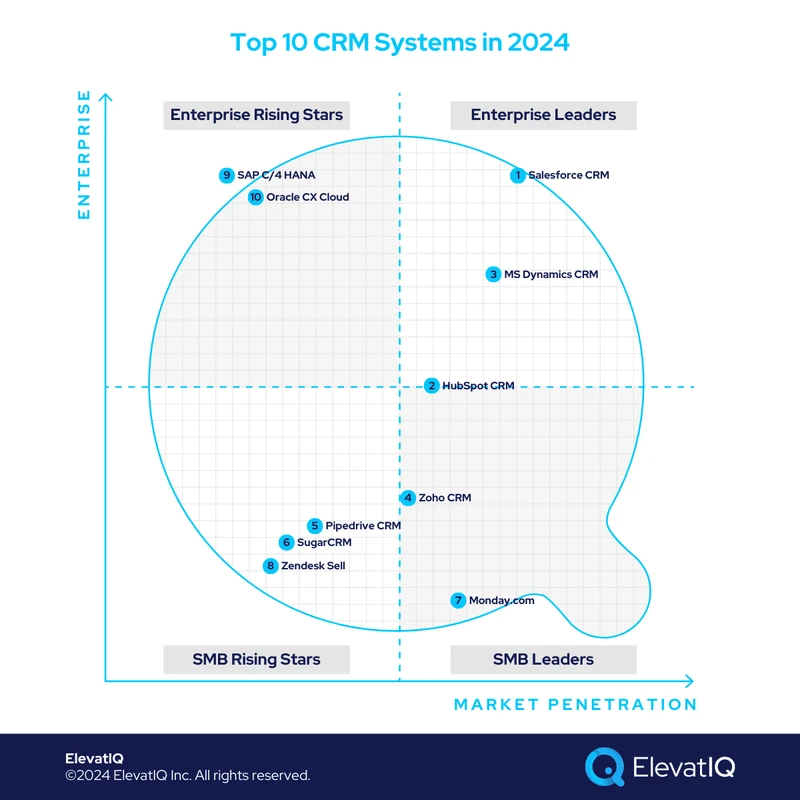
Selecting an enterprise cloud CRM requires aligning architectural governance with operational reality: Salesforce dominates multi-cloud extensibility with over 7,000 AppExchange apps, Microsoft Dynamics 365 offers unmatched price-to-performance within Microsoft 365 environments, and Creatio excels in agentic no-code agility. Rather than seeking a single best platform, enterprise buyers must weigh integration lock-in, seat minimums, and AI automation overhead against long-term maintenance costs. Independent assessments from Nucleus Research document an average return of $8.71 for every $1 spent on CRM software, demonstrating the immense value of centralized pipeline orchestration. At the same time, industry surveys reveal that 86–91% of enterprises are re-evaluating cloud architectures through hybrid rebalancing to regain control over spiraling SaaS commitments and regulatory boundaries.
Enterprise Cloud CRM Platforms: The Bottom-Line Verdict
The best enterprise cloud CRM depends on technical maturity: Salesforce leads in complex multi-cloud ecosystems and Fortune 500 adoption; Microsoft Dynamics 365 delivers lower licensing costs for organizations built on Azure and Teams; Creatio provides superior no-code workflow flexibility; and vertical platforms like Slate dominate industry-specific needs.
Salesforce currently commands a 23.8% global CRM market share and maintains penetration exceeding 80% among Fortune 500 companies. This market dominance stems from its expansive partner network and broad capability set, positioning it as the default choice for massive organizations managing disparate sales units. However, market footprint does not guarantee universal suitability. Salesforce Sales Cloud Enterprise begins at $165 per user per month, establishing a high pricing baseline that escalates rapidly once organizations integrate enterprise identity management, specialized sandbox environments, and advanced support tiers.
Microsoft Dynamics 365 counters this market dominance by lowering software licensing overhead. Its Sales Professional tier enters at $65 per user per month, while the full Sales Enterprise plan costs $105 per user per month. For enterprises already operating within the Azure cloud environment and utilizing Microsoft 365 applications across internal departments, Dynamics 365 eliminates third-party connector tolls. Meanwhile, composable platforms like Creatio challenge both legacy vendors by prioritizing visual no-code configuration over proprietary scripting, reducing reliance on specialized engineering teams. Enterprise RevOps architecture cannot rely on one-size-fits-all tooling; technical leaders must pair organizational maturity directly with platform capabilities.
Platform Architecture and Ecosystem Lock-In
Distributed computing in cloud CRM platforms automates transactions and data processing across remote clusters, eliminating on-premises server racks and specialized local networking equipment. However, architectural design choices determine technical debt, integration friction, and software lock-in over multi-year contract cycles.
Salesforce Lightning and the AppExchange Marketplace
Salesforce founded the commercial cloud CRM category in 1999 and continues to anchor its platform around a central data model that radiates outward. Its Lightning Experience interface is engineered around consumer-grade rep workflows, prioritizing high-velocity pipeline adjustments, automated record enrichment, and contextual opportunity views. The primary engine of Salesforce extensibility is the AppExchange marketplace, which offers over 7,000 third-party applications covering enterprise CPQ, sales enablement, and complex business billing.
The architectural trade-off of this ecosystem is deep technical lock-in. Custom business logic written in proprietary Apex code, coupled with bespoke trigger networks and custom schema objects, creates high migration barriers. When synchronizing millions of records with enterprise ERPs, engineering teams must actively monitor API governor limits and transactional payload caps to prevent pipeline failures. To bypass brittle ETL data duplication, large enterprises increasingly deploy zero-copy data architectures, linking Salesforce Data Cloud directly with external cloud lakehouses to run bidirectional queries without moving underlying datasets.
Microsoft Dynamics 365 and Native Power Platform Fabric
Dynamics 365 approaches enterprise data orchestration from an integrated operating framework. Microsoft completed the transition to a streamlined, flat design interface in Dynamics CRM, emphasizing dense information layouts and functional consistency with Microsoft Office applications. While this layout reduces whitespace, sales representatives familiar with modern consumer interfaces often experience higher onboarding friction compared to Salesforce Lightning.
Architecturally, Dynamics 365 operates as a native component of the Microsoft Power Platform and Azure ecosystem. System records synchronize natively with Microsoft Teams chats, Outlook inboxes, and Power BI reporting engines without requiring middleware connectors. IT architects manage identity through Microsoft Entra ID, applying SCIM 2.0 user provisioning, conditional access policies, and Bring Your Own Key (BYOK) or Hold Your Own Key (HYOK) cryptographic standards. Dynamics 365 integrates with enterprise data strategies through native connectors into Microsoft Fabric, allowing cross-system analytics while reducing the maintenance overhead associated with third-party integration pipelines.
Uncovering Enterprise TCO and Autonomous AI Economics
Procurement Warning: Base subscription tiers rarely capture total enterprise deployment costs. Mandatory onboarding packages, tier-gated workflow automation, third-party certified implementation partner fees, and compute-based AI query overages frequently increase first-year rollout budgets significantly over initial software subscription estimates.
A primary driver of procurement budget overruns is vendor-enforced seat minimums. HubSpot Sales Hub Enterprise lists an entry price of $150 per seat per month, but mandates a strict 10-seat minimum floor before accounting for onboarding fees. SugarCRM enforces a similar restriction, requiring a 15-user minimum on its core tiers. These procurement floors prevent enterprise IT teams from executing small-scale pilot deployments within specialized departments, forcing full financial commitments upfront.
The emergence of autonomous AI agents introduces an entirely new procurement dynamic. Vendors are abandoning standard flat-rate user seat models in favor of consumption-based billing and premium feature tiers. Salesforce powers autonomous customer journeys via Agentforce, which executes multi-step sales workflows and resolves routine inquiries. In high-volume operations, Agentforce achieves an 83% autonomous resolution rate across 32,000 weekly customer conversations. However, organizations must budget for dedicated consumption credits, and specialized packages can significantly increase user licensing costs. In contrast, HubSpot structures its Breeze Customer Agent around transactional consumption, billing organizations a flat $0.50 per resolved conversation.
The operational licensing delta between legacy platforms remains substantial over standard enterprise contract horizons. Microsoft Dynamics 365 Sales Enterprise ($105 per user per month) and Sales Professional ($65 per user per month) provide a significantly lower baseline cost compared to Salesforce Sales Cloud Enterprise ($165 per user per month). This per-seat variance creates a substantial licensing gap before factoring in consumption-based AI agents, certified administrator salaries, or enterprise sandbox licensing.
Head-to-Head Comparison of Top Enterprise Platforms
Direct platform evaluation requires analyzing how each system balances base user pricing, architectural extensibility, and native artificial intelligence workflows. The comparative table below outlines the core specifications, baseline licensing costs, and operational differentiators governing the leading enterprise CRM platforms.
Platform |
Primary Target Use Case |
Starting Enterprise Price |
AI & Automation Mechanism |
Core Architectural Differentiator |
|---|---|---|---|---|
Salesforce |
Global multi-cloud deployments requiring extensive third-party integration |
$165 / user / month (Sales Cloud Enterprise) |
Agentforce autonomous multi-step workflow execution |
7,000+ AppExchange applications; proprietary Apex runtime environment |
Microsoft Dynamics 365 |
Organizations standardized on Azure, Microsoft 365, and Power Platform |
$105 / user / month (Sales Enterprise; Pro at $65) |
Microsoft Copilot integrated with Azure OpenAI services |
Native data integration with Teams, Outlook, Azure Fabric, and Power Apps |
Creatio |
Mid-to-large enterprises seeking composable, no-code process agility |
Custom modular pricing (4.7 / 5 G2 rating) |
AI Studio and Business Studio visual agent builders |
Composable no-code architecture with modular process assembly |
HubSpot Enterprise |
Rapidly scaling enterprises requiring unified inbound marketing and sales |
$150 / seat / month (10-seat minimum required) |
Breeze Customer Agent ($0.50 per resolved conversation) |
Unified single-codebase database spanning marketing, sales, and service hubs |
These structural distinctions illustrate the trade-off between out-of-the-box simplicity and customizable governance. While HubSpot simplifies cross-departmental alignment through a unified codebase, platforms like Salesforce and Microsoft Dynamics 365 provide the relational schema depth required for highly regulated global operations.
Composable No-Code Platforms and Specialized Verticals
Monolithic enterprise CRMs often require prolonged deployment timelines and continuous engineering intervention. As a result, technical architects frequently evaluate composable architectures and vertical-specific platforms designed for distinct operating environments.
Creatio: Agentic No-Code and Composable Architecture
Creatio addresses enterprise agility through a composable, agentic no-code framework, holding a 4.7 out of 5 rating score on G2. The platform breaks application logic down into modular components, allowing business teams to reconfigure operational processes through visual builders rather than manual code edits. System administrators construct custom workflows and deploy task-specific AI agents using Creatio AI Studio and Business Studio without relying on specialized external developers.
This composable framework allows operations teams to adjust opportunity routing, dynamic lead scoring, and complex service approvals in hours rather than development sprints. However, this flexibility requires structured oversight. Implementing composable platforms without strict data dictionary governance can lead to fragmented custom views, prolonged learning curves, and inconsistent cross-departmental reporting.
Industry-Specific Solutions: Slate and Protocol-Native Tools
Broad horizontal platforms often struggle to accommodate the complex compliance and operational flows of specialized sectors without expensive custom builds. In higher education, Technolutions Slate operates as a purpose-built enterprise CRM deployed across more than 2,000 colleges and universities. Slate maintains an unrivaled security record, operating throughout its deployment history with zero recorded security breaches or major service outages.
Through the Slate Integration Center, campus administrators maintain bi-directional synchronization between CRM records, student information systems (SIS), and financial aid databases. Institutional leaders emphasize the functional scope of vertical-native architecture. Felipe Salazar of Orange Coast College observed:
“We’re utilizing Slate well beyond […] what we were thinking of when we first got it, like in terms of […] our operations within the different departments.”
“We’re utilizing Slate well beyond […] what we were thinking of when we first got it, like in terms of […] our operations within the different departments.” Mara Marzocchi of Suffolk University documented: “It’s not just that how we do things has changed—it’s that we can do things that would have been nearly impossible under the previous configuration of systems.”
“It’s not just that how we do things has changed—it’s that we can do things that would have been nearly impossible under the previous configuration of systems.”
At the protocol level, specialized tools like NetHunt CRM provide native integration for the Model Context Protocol (MCP). This capability allows enterprise operations to link external large language models directly into sales pipelines, extracting conversational context from enterprise productivity suites without routing data through complex external integration middle tiers.
Deployment Risks, Rep Adoption, and Hybrid Architectures
The primary point of failure in enterprise CRM implementations is user rejection. When an enterprise instance becomes over-customized, bloated with mandatory validation rules, or bogged down by slow interface navigation, administrative overhead increases. Instead of logging touchpoints, sales representatives abandon the CRM platform and revert to tracking opportunities across private spreadsheets, destroying RevOps data integrity.
Global regulatory mandates—including the European Union Data Boundary, regional privacy standards, and local residency requirements—prevent global organizations from routing all corporate records through a single cloud tenant. In response, vendors offer localized data solutions such as Salesforce Hyperforce, allowing enterprises to host customer data within specific sovereign jurisdictions while retaining consolidated global reporting structures.
Standard CRM platforms also struggle to capture offline and real-world buyer interactions. Experiential touchpoints—such as corporate trade shows, customer summits, and live product activations—generate high-value first-party intent data that standard CRM schemas cannot natively process. Platforms like AnyRoad bridge this operational gap by capturing structured, consented first-party data at event check-in, registration, and post-experience surveys, feeding enriched buyer profiles back into Salesforce, Dynamics 365, or HubSpot via webhooks and native APIs.
Shortcut: Mitigate enterprise contract risk by conducting a live sales cycle pilot. Run at least one full deal cycle across an active sales pod using a trial environment before committing to a multi-year annual contract, validating real-world rep workflow velocity and mobile sync conflict handling.
Strategic Selection Framework by Organization Profile
To choose an enterprise cloud CRM, map stack requirements directly to vendor strengths: pick Salesforce if extensive multi-system customization and a 7,000-app marketplace are required; choose Microsoft Dynamics 365 to maximize existing Office and Azure licenses at lower per-seat costs; select Creatio for agile, no-code process design; and deploy dedicated platforms like Slate for specialized vertical ecosystems.
Evaluating custom-built CRM architectures against commercial platform-based software highlights distinct operational trade-offs. Developing a bespoke proprietary CRM provides an organization with absolute authority over source code, database structures, and internal security protocols, completely eliminating recurring seat licensing costs. However, platform-based enterprise systems drastically reduce upfront capital requirements, automate complex transaction logic out of the box, and shift server maintenance to cloud infrastructure. For most organizations, commercial cloud platforms provide the most viable operational model when governed with clear architectural discipline.
- Global Multi-Cloud Enterprises: Select Salesforce Sales Cloud Enterprise ($165/user/month) when business units require deep extensibility across disparate ERP platforms, localized compliance via Hyperforce, and access to over 7,000 AppExchange partner tools, assuming the organization can support dedicated developer headcount and variable Agentforce automation charges.
- Microsoft-Standardized Organizations: Choose Microsoft Dynamics 365 Sales Enterprise ($105/user/month) or Sales Professional ($65/user/month) to capitalize on unified Azure tenant governance, integrated Power BI reporting, and native collaboration within Microsoft Teams and Outlook.
- Process-Agile Enterprise Teams: Deploy Creatio to capitalize on composable no-code agility via Business Studio and AI Studio, enabling non-technical teams to iterate complex operational flows without writing proprietary scripts.
- Higher Education Institutions: Standardize on Technolutions Slate to leverage proven bi-directional student information integrations and an infrastructure record verified by zero recorded security breaches or major outages across 2,000+ campus deployments.
- Marketing-Centric Mid-Market Enterprises: Adopt HubSpot Sales Hub Enterprise if unified inbound marketing integration outweighs advanced custom schema requirements, accounting for the 10-seat procurement floor ($150 per seat monthly) and the $0.50 per-resolution Breeze AI consumption model.
- Global Multi-Cloud Enterprises: Select Salesforce Sales Cloud Enterprise ($165/user/month) when business units require deep extensibility across disparate ERP platforms, localized compliance via Hyperforce, and access to over 7,000 AppExchange partner tools, assuming the organization can support dedicated developer headcount and variable Agentforce automation charges.
- Microsoft-Standardized Organizations: Choose Microsoft Dynamics 365 Sales Enterprise ($105/user/month) or Sales Professional ($65/user/month) to capitalize on unified Azure tenant governance, integrated Power BI reporting, and native collaboration within Microsoft Teams and Outlook.
- Process-Agile Enterprise Teams: Deploy Creatio to capitalize on composable no-code agility via Business Studio and AI Studio, enabling non-technical teams to iterate complex operational flows without writing proprietary scripts.
- Higher Education Institutions: Standardize on Technolutions Slate to leverage proven bi-directional student information integrations and an infrastructure record verified by zero recorded security breaches or major outages across 2,000+ campus deployments.
- Marketing-Centric Mid-Market Enterprises: Adopt HubSpot Sales Hub Enterprise if unified inbound marketing integration outweighs advanced custom schema requirements, accounting for the 10-seat procurement floor ($1,500/month baseline) and the $0.50 per-resolution Breeze AI consumption model.
FAQ
What hidden fees inflate enterprise cloud CRM costs beyond the per-user license?
Total deployment budgets escalate through mandatory onboarding service packages, steep price gating between subscription tiers, third-party certified implementation partner fees, and vendor-enforced seat minimums. For example, HubSpot Sales Hub Enterprise enforces a 10-seat minimum ($150 per seat monthly), while SugarCRM requires a 15-user floor on core tiers.
How do enterprise autonomous AI agent pricing models differ between CRM vendors?
Vendors utilize contrasting pricing structures for autonomous intelligence: Salesforce pairs core subscriptions with Agentforce autonomous workflows that execute multi-step operations across complex customer service journeys, whereas HubSpot prices its Breeze Customer Agent through a direct consumption model, billing organizations $0.50 per resolved customer interaction.
Why are 86% to 91% of enterprises planning hybrid rebalancing or cloud repatriation?
Organizations face escalating subscription costs, strict data residency requirements, and sovereignty mandates across international jurisdictions. Platforms like Salesforce Hyperforce enable localized regional cloud hosting, but many organizations maintain hybrid architectures to preserve complete on-premises governance over sensitive records while using cloud engines for transaction processing.
What is the operational risk of over-customizing an enterprise cloud CRM?
When an enterprise instance becomes over-customized or under-maintained, administrative overhead increases. Instead of streamlining sales, excessive required fields, convoluted object models, and sluggish interfaces frustrate sales representatives. This operational friction frequently causes reps to abandon the CRM platform entirely and revert to private, ungoverned spreadsheets.