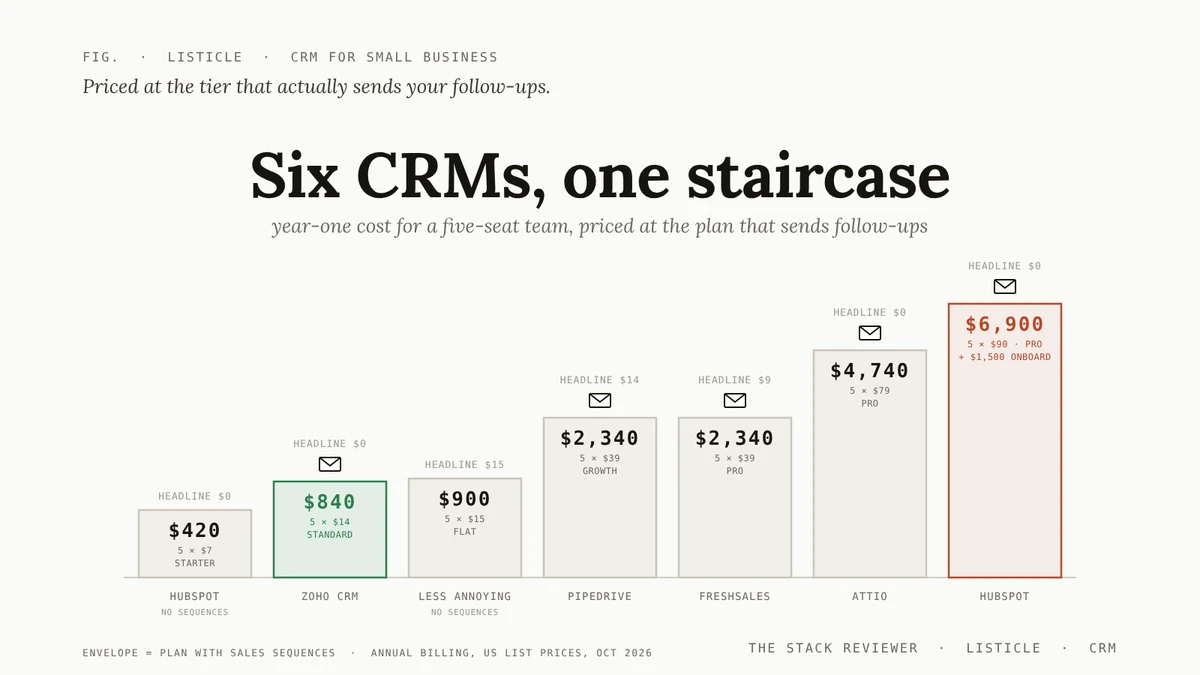
For most small businesses, lightweight pipeline tools serve micro-teams needing affordable deal tracking, dedicated sales platforms maximize pipeline velocity, inbound suites provide starting points for content capture, and specialized systems support integrated domestic calling and text messaging. While small enterprises generate a substantial portion of private-sector commercial receipts nationwide, software deployments routinely stall when buying decisions prioritize extensive feature checklists over daily adoption and long-term operating costs. Selecting the right platform requires evaluating total software expenditure across three years alongside operational essentials like accounting integration, telecommunications compliance, and data exit rights.
Top CRM Picks for US Small Businesses by Category
The best CRM for small businesses depends on operational focus: lightweight platforms lead for micro-teams seeking affordable deal tracking; sales-focused tools win for pipeline management; marketing-driven suites offer entry-level packages but escalate steeply; and communication-focused platforms excel for integrated calling and two-way SMS compliance.
Every commercial operation maintains distinct sales rhythms, meaning software built for one industry often creates administrative bottlenecks in another:
- Lightweight CRM: Built for micro-teams, solo operators, and startups seeking an uncluttered pipeline interface without enterprise overhead.
- Pipeline-Centric CRM: Tailored for dedicated sales teams focused on deal velocity, visual pipeline staging, and disciplined activity logging.
- Inbound Marketing CRM: Suited for marketing-driven organizations that capture leads via web forms, content downloads, and organic web traffic.
- Outbound Sales CRM: Designed for inside sales teams requiring built-in voice calling, power dialers, and compliant outbound text messaging.
- Integrated Operations CRM: Engineered for companies combining pipeline tracking with field operations, physical inventory deduction, and purchase orders.
An HVAC contractor coordinating residential service calls operates under entirely different constraints than a B2B firm negotiating six-figure retainer agreements. Operational fit matters far more than an exhaustive feature inventory.
The 3-Year Ownership Cost: Calculating Beyond Monthly List Prices
Evaluating software based solely on the monthly per-user rate displayed on vendor pricing pages produces severe budget miscalculations. To budget multi-year ownership costs, small business operators must calculate Total Cost of Ownership across representative team sizes combining base seat licensing, upfront onboarding packages, contact database growth, monthly middleware connector subscriptions, and outbound telephony add-ons. A small sales team paying an entry-level per-seat rate often discovers their annual spend doubles or triples over time as contact databases expand and essential operational capabilities require higher tier upgrades.
Contact Tier Creep and Seat Minimums
Pricing models structured around contact volumes present a major financial trap for growing firms. An entry-level plan may cap marketing contacts at a low threshold, and expanding past that limit routinely triggers automatic tier escalations that double or quadruple base subscription costs. Storing dormant past clients, unsubscribed leads, or vendor directories quickly inflates software bills without generating revenue.
Seat minimums compound this issue. Several vendors lock advanced capabilities behind tiers that enforce minimum purchase commitments—such as requiring a five-seat subscription even when an owner only employs two active sales representatives. Teams must calculate whether their current head count justifies paying for empty software licenses.
Mandatory Onboarding and Implementation Fees
Transitioning beyond starter plans into intermediate tiers frequently involves non-negotiable professional onboarding fees. Vendors often require one-time setup packages before granting access to automated lead routing, custom reporting, or deep platform permissions. These implementation charges must be calculated as upfront capital expenditures rather than amortized operational expenses.
Additional hidden cost drivers include:
- Middleware Connector Subscriptions: Paying recurring monthly fees for third-party automation tools to bridge data when native software connections are missing or paywalled.
- Add-On Document and File Storage: Surcharges incurred when client contracts, inspection photographs, and historical email attachments exceed low default storage ceilings.
- Outbound Telephony Overages: Per-minute voice charges, toll-free number leasing, and carrier surcharges associated with integrated browser dialers.
US Operational Essentials: Accounting Sync and Telephony Laws
A CRM operating in isolation creates duplicate administrative work and exposes businesses to regulatory liabilities. In the United States, two infrastructural areas require careful scrutiny prior to signing a contract: direct financial software connectivity and telecommunications legal compliance.
Direct two-way synchronization with dedicated accounting software is critical for accurate bookkeeping. A true two-way integration allows sales reps to see paid invoice statuses, outstanding receivables, and customer balances directly inside the contact record, while automatically turning closed CRM deals into draft invoices. Relying on custom webhooks or third-party middleware frequently leads to sync failures during software updates, resulting in inaccurate sales tax calculations and missing transaction records.
Deploying CRM platforms with built-in voice calling and text messaging introduces strict US regulatory requirements:
- A2P 10DLC Brand and Campaign Registration: US mobile carriers require businesses sending SMS messages from software applications to complete Application-to-Person 10-Digit Long Code registration. This process verifies business identity via Employer Identification Numbers (EIN) and reviews message templates. Failure to register results in high message failure rates, carrier blocking, and steep per-message penalty fines.
- STIR/SHAKEN Caller Authentication: Outbound dialers must comply with federal standards designed to combat illegal robocalls, ensuring company caller IDs display as verified rather than flagged as spam or fraud risk.
- Call Recording Consent Laws: Operating across state lines introduces severe wiretapping liabilities. Multiple US states require two-party (all-party) consent before recording phone calls, whereas federal law and other states require only one-party consent. Integrated CRM dialers must support automated consent greetings or geographic recording toggles to maintain compliance.
Five Vetted CRMs for US Small Teams
Selecting software requires aligning team capabilities with specific operational requirements. The following five platforms address distinct small business workflows while maintaining transparent operating models.
Zoho Bigin: Best Lightweight Value for Micro-Teams
A lightweight pipeline tool strips away the configuration complexity that burdens enterprise platforms, offering micro-businesses and solo operators an intuitive system. Built specifically around deal tracking, it allows teams to manage separate sales, onboarding, and fulfillment pipelines without extensive software training. Contact timelines consolidate emails, notes, and tasks in a clean interface.
The platform maintains an entry price well below typical industry benchmarks, making it one of the most accessible options for businesses leaving spreadsheets. The platform connects natively with other applications in its broader software ecosystem, including accounting and electronic signature tools. The primary limitation surfaces when teams require complex multi-branch marketing automation, which necessitates migrating to larger CRM tiers.
Pipedrive: Best for Visual Sales Pipelines and Deal Velocity
The platform centers entirely on activity-based selling methodologies. Its core interface displays sales stages horizontally, allowing representatives to drag and drop deals while immediately identifying pending tasks. If a deal lacks a scheduled follow-up activity, the system visually highlights the record, encouraging disciplined sales habits across the team.
The platform provides clean email tracking, meeting scheduling links, and visual sales forecasting. While its deal-closing mechanics are exceptionally strong, the software lacks built-in advanced marketing tools and comprehensive native billing. Connecting deep accounting workflows often requires third-party marketplace integrations, and adding voice calling capabilities requires separate add-on subscriptions.
HubSpot CRM: Best Free Tier with Sharp Mid-Market Upgrade Walls
The platform provides one of the most generous entry points on the market, offering free contact management, lead capture forms, email marketing templates, and basic deal boards. For early-stage companies testing digital marketing workflows, the free plan provides immediate operational utility without financial commitment.
The platform becomes challenging when expanding beyond entry levels. Bridging sales automation with advanced marketing requires upgrading into paid Starter or Professional tiers, where prices scale rapidly into hundreds of dollars monthly. Furthermore, mandatory professional onboarding fees on higher tiers represent a substantial upfront expense that can strain modest operating budgets.
Salesmate: Best for Integrated Calling and SMS Outreach
The platform is built for inside sales teams that rely heavily on direct customer communication. The platform integrates a full cloud phone system, power dialer, and two-way SMS messaging directly into its core pipeline interface, eliminating the need to stitch together disparate communication tools.
The software simplifies US telecommunications compliance by providing clear pathways for A2P 10DLC registration, helping businesses maintain legitimate SMS delivery rates with domestic carriers. Its automated outreach sequences allow teams to coordinate personalized emails, text messages, and call tasks from a single dashboard. Businesses that do not conduct outbound phone outreach, however, may find the telephony-centric interface more complex than necessary.
Odoo CRM: Best Unified Platform for Sales and Inventory
The CRM functions as a component of an open-architecture business management suite. It is ideally suited for trade contractors, light manufacturers, and wholesale distributors who must connect sales pipeline progress directly to warehouse stock levels, purchase orders, and customer billing without intermediary software.
A closed deal converts immediately into a sales order, reserves inventory, and generates customer invoices within the same unified database. While the single-app pricing model is exceptionally cost-effective, deploying the platform requires careful initial setup and administrative oversight. The platform rewards structured business processes but demands more technical discipline during onboarding than standalone pipeline tools.
Comparing the Top Small Business CRMs
Selecting software requires evaluating baseline costs against essential operational capabilities and long-term commitments. To budget multi-year ownership costs, small business teams must calculate base monthly seat licensing alongside mandatory onboarding packages, contact creep fees, telephony add-ons, and recurring monthly middleware connector charges. The comparison below reviews the five top platforms on pricing entry points, modeled 3-year Total Cost of Ownership drivers, accounting integration depth, telephony readiness, and practical team fit.
CRM Platform |
Starting Price (Per User/Mo) |
Modeled 3-Year TCO (2 to 5 Seats) |
Native QuickBooks Online Sync |
Built-in 10DLC SMS Support |
Primary Ideal Use Case |
|---|---|---|---|---|---|
Zoho Bigin |
$7 – $12 |
Base seats at $7 – $12 monthly per user across 3 years; no mandatory onboarding fees; requires telephony add-on and optional $20 – $50 monthly middleware. |
Yes (via Zoho Books/QBO integration) |
Third-party add-on required |
Micro-teams & simple pipelines |
Pipedrive |
$14 – $24 |
Base seats at $14 – $24 monthly per user across 3 years; requires telephony add-ons and $20 – $50 monthly middleware for deep accounting sync. |
Tier-dependent / App Marketplace |
Third-party add-on required |
Visual activity-based deal closing |
HubSpot CRM |
Free ($15 – $20 paid starter) |
Base starter seats at $15 – $20 monthly per user across 3 years; escalates sharply with mandatory onboarding fees and contact creep past 1,000 contacts. |
Native on paid tiers |
Marketplace integrations required |
Inbound content & marketing capture |
Salesmate |
$23 – $29 |
Base seats at $23 – $29 monthly per user across 3 years; native 10DLC SMS and calling included; native two-way QuickBooks sync eliminates middleware. |
Native two-way sync |
Native built-in (10DLC ready) |
High-volume outbound calling & SMS |
Odoo CRM |
$0 (Single App) / $24.90 (All Apps) |
$0 single-app plan or $24.90 monthly per user all-app plan across 3 years; modular accounting eliminates middleware, with self-directed setup. |
Native modular accounting |
Modular / Gateway configuration |
Combined sales, inventory & invoicing |
CRM Platform |
Starting Price (Per User/Mo) |
Native QuickBooks Online Sync |
Built-in 10DLC SMS Support |
Primary Ideal Use Case |
|---|---|---|---|---|
Zoho Bigin |
$7 – $12 |
Yes (via Zoho Books/QBO integration) |
Third-party add-on required |
Micro-teams & simple pipelines |
Pipedrive |
$14 – $24 |
Tier-dependent / App Marketplace |
Third-party add-on required |
Visual activity-based deal closing |
HubSpot CRM |
Free ($15 – $20 paid starter) |
Native on paid tiers |
Marketplace integrations required |
Inbound content & marketing capture |
Salesmate |
$23 – $29 |
Native two-way sync |
Native built-in (10DLC ready) |
High-volume outbound calling & SMS |
Odoo CRM |
$0 (Single App) / $24.90 (All Apps) |
Native modular accounting |
Modular / Gateway configuration |
Combined sales, inventory & invoicing |
While base rates remain affordable across starter tiers, operational expenses increase based on add-on modules and database expansion. Confirming native feature coverage prior to purchase prevents unexpected software costs down the road.
Data Lock-In and Portability: What Happens When You Cancel?
When canceling a small business CRM, platforms readily export basic contact CSVs but often purge relational history. Deal progression timelines, native email thread histories, custom note timestamps, and workflow automations are rarely portable, requiring structured quarterly data backups to prevent complete institutional memory loss.
Relational databases connect disparate pieces of information: which sales representative spoke to a client on a specific afternoon two years ago, why a discount was approved, or what specific issues arose during an onboarding call. When moving to a new system, those historical connections are severed. Standard CSV exports do not maintain threaded email dialogues or date-stamped internal commentary.
To protect institutional memory and prevent complete data lock-in, small business owners should follow three protective measures:
- Schedule Quarterly Database Dumps: Export complete relational data sets—including activity tables, notes, and deal stages—in CSV or JSON formats and archive them to secure internal cloud storage.
- Centralize File Attachments: Store executed customer agreements, technical specifications, and project estimates in a dedicated company storage drive rather than leaving them exclusively inside CRM attachment silos.
- Document Workflow Automation Logic: Maintain an offline operating manual detailing lead assignment rules, pipeline stage criteria, and email follow-up sequences so automation can be rebuilt quickly in any replacement software.
FAQ
What is A2P 10DLC and why does my small business CRM need it?
A2P 10DLC is a US telecommunications standard requiring businesses sending SMS from application software to register brand identity and campaign use cases with mobile carriers. Without approved registration, US carriers filter outbound customer texts, throttle throughput, and apply per-message penalty surcharges.
Can I connect QuickBooks Online to a small business CRM without Zapier?
Yes. Platforms such as Zoho, HubSpot, and Salesmate offer direct, native integrations with QuickBooks Online. These tools sync contact information, sales invoices, and payment statuses directly between databases, bypassing third-party connector tools like Zapier and avoiding sync latency or webhook errors.
How do customer support hours differ between entry-level and enterprise CRM plans?
Entry-level CRM tiers routinely restrict customer support to community forums or asynchronous email tickets with 24-hour or longer response windows. Access to real-time live chat or direct US phone support during standard business hours is typically paywalled behind professional or enterprise service tiers.
Is a free CRM plan viable for a growing team?
Free plans provide a functional starting point for basic contact tracking and manual deal updates. However, they enforce strict limits on active sales pipelines, email marketing volumes, custom reporting capabilities, and administrative roles, which usually prompts an upgrade once deal volume accelerates.